MUSIC NOTES
and musings…
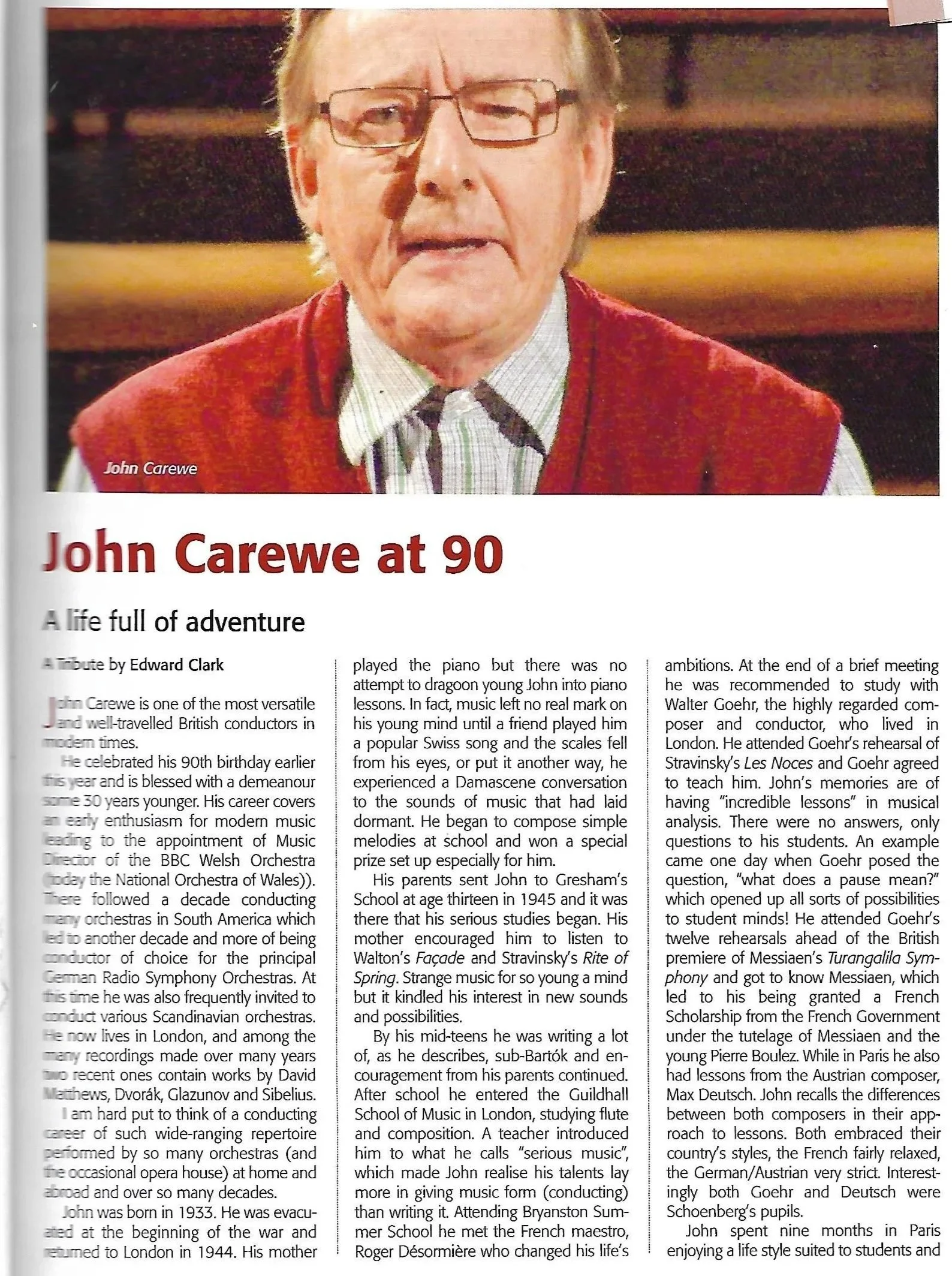
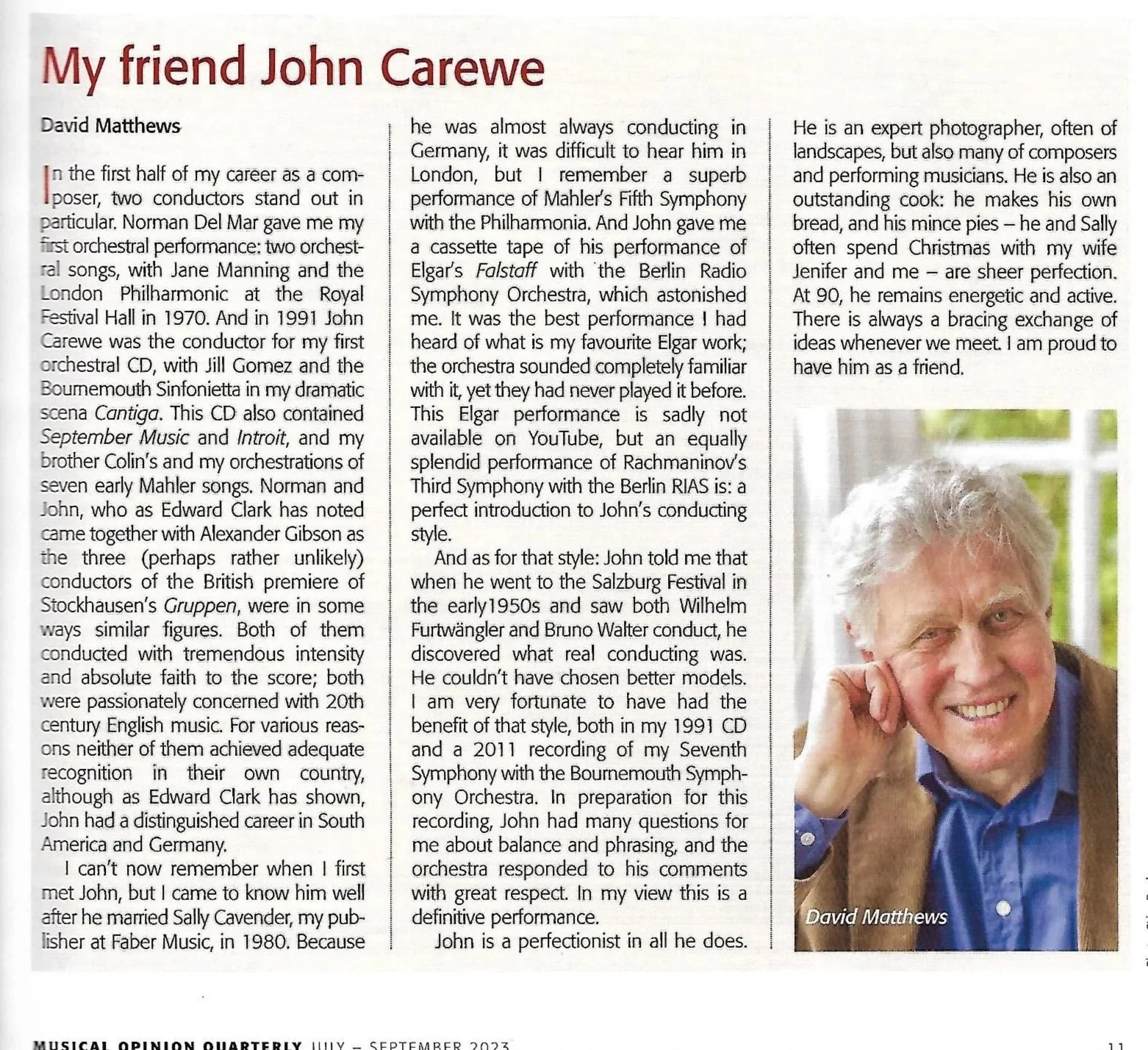
An interview with
John Carewe on Musical Structure
14th August 2024
John Carewe is a British conductor (and teacher). Very early in his student career at the Guildhall School of Music, Carewe gave up his original intention of becoming a composer and turned to conducting. His teachers, nevertheless, were all composers: Walter Goehr and Max Deutsch (both Schoenberg pupils), Messiaen (with whom he studied in Paris on a French Government scholarship) and Pierre Boulez.
In 1958, he founded the New Music Ensemble and gave many British premieres of music by composers including Birtwistle, Boulez, Bennett, Maxwell Davies and appeared at most of the major British festivals, including the BBC Proms. He was one of the three conductors in the first British performance of Stockhausen’s Gruppen given in Glasgow in 1961. In 1966, at the invitation of Sir William Glock, Carewe became principal conductor of the BBC Welsh Orchestra, and held the post until 1971. From 1974 to 1986, he was Music Director of the Brighton Philharmonic Society, and was principal conductor of The Fires of London between 1980 and 1984. From 1993 to 1996, Carewe was Generalmusikdirektor (General Music Director) of the Chemnitz Opera, which encompassed its resident orchestra, the Robert-Schumann-Philharmonie.
He frequently worked with the Bundesjugendorchester and taught conducting at both the Royal Academy of Music and the Royal College of Music in London. He has also served on the jury of the Gustav Mahler Conducting Competition. Carewe's recordings include Debussy's Pelléas et Mélisande (recorded in 1988 after performances at Nice Opera), Milhaud's La Création du Monde and Stravinsky's The Soldier's Tale (recorded with a chamber ensemble from the London Symphony Orchestra).
Carewe is well-known as having been a mentor of Sir Simon Rattle.
Background
I suppose I came to music quite late in life – I must have been eight or nine when I discovered it. It hit me like a sledgehammer. Previous to that I knew absolutely nothing about music – I was completely feral! The war started in 1939, when I was six, and we were evacuated to Westward Ho! in Devon. All the adults were either away fighting or busy doing other things, so I was basically left for quite long periods of time on my own. Once I was back in London, I was playing with a friend and I heard some music. I was knocked out by it. I was rather innocent and assumed that if you loved music then you wrote it, so I thought I was in fact a composer! I took up the flute and the piano along with composition, and eventually went to the Guildhall School of Music and Drama.
There I was lucky enough to have a very good teacher, Alfred Nieman, who introduced me (in 1951) to the works of Bartok and Stravinsky, which I hadn’t previously known. Well, I realised very quickly that if these gentlemen were composers, I wasn't. But I did feel quite strongly that I had an ability to give music its shape and its form i.e. per-form it, so I switched over to studying conducting. At the Guildhall I had a very nice teacher called Joseph Lewis who had been a rather famous choral conductor before the wars.
I was taught the usual absolute nonsense. My instincts told me that it was wrong, and that nothing they were telling me was actually relevant. Luckily, I went on a summer course where Roger Désormière was a guest conductor. He was one of the most famous French conductors – his recording of Pelléas et Mélisande is still regarded as the touchstone. He was a very progressive man, and I paid him to have a little lesson on The Rite of Spring, which was eye-opening, and he told me that I should study with somebody in London called Walter Goehr. When I got back to London I got in touch with him and went to some rehearsals and a performance of Les Noces that he was doing for the BBC – I was absolutely blown away by the whole thing, and for reasons completely beyond my comprehension he took me on as a pupil.
Eventually, in order to try and find some money to help pay him for the lessons he gave me, I got together a small group of five or six of us. We would all go to his house, contribute a fiver each, and he would give us a two or three hour lesson on all sorts of very interesting things. That's where I really started to learn what music was about and how to study it. He conducted the British premiere of Messiaen’s Turangalîla-Symphonie, and I went to all twelve rehearsals he did with the LSO and their two performances. I think it nearly bankrupted the BBC but I met Messiaen and his wife Yvonne Loriod. I can’t remember how it came about, but I discovered a misprint in the Turangalîla-Symphonie score. Messiaen was absolutely certain that there were no misprints in it at all, but I showed him there was a place in one of the movements where (...now just sit down quietly...) the woodblock should have been tied over and it wasn't! So I was accepted into his class at the Conservatoire Nationale in Paris – I got a little scholarship from the French government.
In Paris I also studied with Max Deutsch, who was a pupil of Schoenberg in the 1900s, and visited Boulez’s apartment with Sandy [Alexander, Walter’s son] Goehr three or four times to hear his analysis of Webern's scores and discuss the music etc. As you may have gathered, I studied conducting with composers, not conductors. Walter Goehr was also a conductor/composer who had studied with Schoenberg. You've got to understand that to study with Schoenberg in Berlin in 1930 meant that you were one of the most talented composition students in Germany (if not Europe). Goehr was a remarkable man – the great thing about him was that his interests were so wide-ranging. He gave the first modern performances of Monteverdi’s The Coronation of Poppea and Vespers for the Blessed Virgin as well as the first performances of Tippett’s A Child of our Time, Britten’s Serenade, and the complete works of Webern for the BBC. Unfortunately for him, he was closely followed by a whole lot of modern early music specialists, so he rather disappeared off the scene (although most of them used his vocal scores for their rehearsals etc.) But that was who he was: always right at the forefront.
I can remember when he was rehearsing The Coronation of Poppea in Maida Vale Studio 1 with the Philharmonia Orchestra, (and lots of early instruments). In the interval of the one of the rehearsals he was sitting at the piano with a cigarette stuck in his left hand fingers entertaining some of the players playing his theme song for the next Hollywood blockbuster! He was that sort of musician – he could do anything – and he was an absolutely huge influence on my life.
Do you think having composer/conductors as your teachers worked in your favour?
Well, yes. That was the case with both Walter Goehr and Max Deutsch, and I cannot understand why more people don't study with composers. Performing music is not a question of playing what's on the page, it's about understanding why it's on the page and what the page tells you about it. If you were to take a great poem and read it purely and simply as it is on the page, everybody would go to sleep. Structure is one of the most important features of a poem – you’ve got to be able to pace it. You need to understand the implications, the nuances, the references and the things that are implied but not expressed. There’s a whole universe behind it. It's the same with music – you can't just play a Beethoven symphony by playing the notes. You have to understand what he was doing, why he was doing it and what he was trying to achieve. That's why many composers have an advantage when they take up conducting.
What about Boulez?
Well, no, that is interesting. He had little concept about how music was written in the Classical period.
Oh yes. There was that famous quote of his: ‘it is not enough to deface the Mona Lisa because that does not kill the Mona Lisa. All the art of the past must be destroyed’.[1]
Yes, I know. He was a very great man, a huge musician – he had a wonderful ear and knowledge. But he did not understand the major/minor tonal system (i.e. what I'm about to talk about). It was not his language – he did not use it, he had no empathy for it. He believed that if he played what was on the page it was enough. It isn't.
Musical Structure
One of the questions that I always challenge young conductors with if they come to talk to me is: ‘what is one of the most difficult things a composer has to do?’ They all scratch their heads, and come up with some quite interesting answers. But the answer I'm after is: holding an audience’s attention for more than three minutes. You can write a three-minute piece without words and the human brain can just about hold it. With words you can write an enormous amount – the structure of the music of Bach and Monteverdi (among others) came from the text, and that gave the music its backbone.
But what about writing a twelve-minute piece which can hold everybody's attention from beginning to end? Of course, that is the problem. How do you create a structure that will hold the music and the audience for that length of time? What I then usually point out to the youngsters is that, up to middle Haydn, music was largely dependent on words, or structures such as the Passacaglia, Fugue or Variations. People understood this language: not exactly static, but certainly not progressive in the way it was soon to become. By some miracle, Haydn, in his middle age, discovered what (I call) the Major/Minor Tonal System can do: a system or language whereby a key is established, and from that key you can blossom out and build bridges to all sorts of other places and regions.
It is absolutely essential to understand that we are talking about a system where the subdominant (or a substitute subdominant) is followed by the dominant and leads to the tonic. Just moving between the dominant and tonic means nothing because that tonic could now become a dominant and you go round in circles.
Before I continue let me digress with a short imagined history of ‘The Bridge’.
The first bridge would have been a tree that fell across a stream. The next development was to have a longer bridge of two arches with a rock or stone in the middle and another tree – and so on. Then people began to build stone arches, and these spans became longer. There would also have been bridges made from climbing plants across ravines. Then somebody put the two together, built towers and suspended the ravine bridge from towers. That is also the history of symphonic first movements!
The idea of what a first subject is, is somehow misunderstood. It's there to tell the listener, ‘this key is important. Remember’. The composer is then able to start to build, to make a transition passage or arch and then establish a second key, nearly always the dominant. In order to make it quite clear that this moment is also structurally important there is another theme, a second subject (occasionally this theme can be the same as the first, acknowledging that the function of a subject is to draw attention to a particular key region). The composer then goes on and builds until eventually he gets to a point where the arch completes itself, you get to the double bar and repeat. So this (exposition) is really a huge bridge.
The development (another huge bridge) is not really about working with the subjects. Of course, it's useful to use the material already presented because you don't want to overload people with too much music, but the essence of a development is quite simply to modulate away from the home key so as to bring you to a position where the tension is so great that when you come back to the tonic you feel an enormous satisfaction, almost relief to be home again. Basically it is about building bridges (or rather one bridge with many arches). This ability to build is the essence of the Major/Minor Tonal System.
One of my better pupils studied in Amsterdam about a year or two ago. He asked the powers that be there, ‘when did the term Sonata Form first appear?’ I was awfully pleased to discover, as I guessed, that it was in 1816. Sonata Form is the outcome of the Major/Minor System – it is the logical way to use its tonal harmony and is actually organic to the language not a mould into which you pour music. It doesn't work if you have a different musical language; it won't work with modal music, or twelve-tone music. A classic example of this is Schoenberg’s Wind Quintet. I don't know why he did this: he wrote the Quintet with a First Subject, a Second Subject etc. It's nonsense, you can't do it. If you don't have tonality, you can't have the same foundation points. The essential thing to understand is that the harmony is what leads. It's not the melody that is being harmonised, it's the melody which is taking its life from the harmony. Many conductors don't realise that the most important part in the orchestra is the cello/bass/bassoon area – that's where you have to really listen. If you have got that structurally going, the rest of the orchestra will follow and know exactly what to do. You can basically leave the tune alone, that looks after itself.
The real problem for us is that we no longer hear tonal music correctly, or at least as it was heard in the time of Haydn, Mozart and Beethoven. Just imagine you're living in Vienna in 1800 and have never heard Schumann or Wagner or Strauss – nothing except the simple harmonies that were used up to that time. The most outrageous and modern iconoclast in that era was a guy called Beethoven. Beethoven's understanding of this language and harmony is absolutely astonishing. One of the things I have not discussed seriously with anybody is that I'm absolutely certain if you approach Beethoven's works thinking about who they were written for, you have a much clearer idea of why he's doing what he does. He had a coterie of friends who were phenomenally gifted and interested in music. Beethoven was paid to live in Vienna. He was threatening to go to the North of Germany as a Kapellmeister and earn a living because he wasn't doing so well in Vienna, but three very rich Counts got together and agreed to pay him a life stipend if he stayed and composed there. These people were highly intelligent and musically very sophisticated – Beethoven was writing for them, to astonish them. His unbelievable development of musical structure through harmonic manipulation was inspired by his wish to show his admirers just what he could do.
If I were to play you the opening notes of Beethoven’s
5th Symphony – G, E flat / F, D – bare, melodically without the rhythm, and asked you ‘what's the next note?’ Given the background of the first listeners to this Symphony and their innocent ears, uncorrupted by all the music that was to come, you would say the next note should be E flat (implying E flat major). But in the symphony the next chord is C minor. What is interesting is that Beethoven proceeds to establish C minor in the next few bars, but places the Second Subject, when it comes, in E flat and stays there all the way to the double bar, meaning that with the repeat the opening bars really are in E flat! OK, C minor is the relative minor of E flat, so the symphony will be in E flat (!).
Beethoven knew that this would surprise and intrigue his sophisticated listeners. He is in fact playing ‘cat and mouse’ with them.
Let me now turn to how I believe this affects the conductor.
One of the most fascinating half hours I spent with Walter Goehr was when he discussed the use of the pause in music of this era. Some pauses are long, some shorter, some even a substitute for a four-bar phrase. Some pauses you continue from directly, some you make a short ‘breath’, some a longer ‘breath’, some even a proper hiatus.
So, it is my belief that in the Fifth Symphony there should be a short break before the second phrase; after all the motive is simply the interval of a third, followed by a repeat a tone lower. I don’t think the two ‘two-bar’ statements are really one ‘four-bar’ statement. The reason for conductors to go on straight after the first pause is because that is ‘easy’, whilst to start again is ‘risky’ (they think – it isn’t!). But, crucially, I am sure that there should be a considerable wait after the second pause because the C minor should be a shock, a surprise, and a complete change of atmosphere – from the strong and powerful to the mysterious – a ‘what are we doing here?’ feeling.
I played this example to a very talented composer I know and he disputed my conclusions very strongly. Then we came to the incredible realisation that of course he could not hear what I was asking him to hear at the intensity I wanted, because if he had he wouldn't have been able to write the music he does write. He would have been overwhelmed by the implications of tonality. He's in a much freer world now, and so are we, but we must try to think back to 1800 and hear as they did..
We’ve been discussing structure, harmony and tonality. Is this type of analysis always part of your preparation with the pieces you conduct?
Well, of course.
I ask because I have often found that conductors don’t engage with harmony and tonality as much as they do rhythm.
Well, they’re completely ignorant! This is what’s wrong. I studied with two pupils of Schoenberg, who wrote the definitive book on harmony. If you don’t understand the harmony, you can’t understand anything. They’re always fiddling around with the clothing of the piece and never getting down to the bone structure.
Well, sometimes they talk about harmony as if it’s like the contours of a map i.e. it shows you the shape of the piece.
Well, there is a point there, but I doubt very strongly that they are talking about harmony in the way I am. You wouldn’t get Bruno Walter or Furtwängler talking like that – they would be talking about the structure. And regarding rhythm: are they going to say you’ve got play at the same tempo throughout? I’m more interested in all the fluctuations. The harmony and structure show you where you must move onwards or backwards. You know, the ‘elephant in the room’ is that we all know that Beethoven played with tempo modifications (all the commentators noted that) yet we are told nowadays that this is wrong for us to do. Yes, it is wrong if it is wilful, purely done for ‘feeling’, but if it is structural, then it is right, and the feeling follows.
I’ll give you a very short, little example. Do you know Beethoven’s Symphony No. 2 in D major? It starts with a fermata in octaves of a D – ‘babaaa!’ – that’s just there for no other purpose other than to say ‘wake up!’ But so many conductors go straight on afterwards, there should be a slight comma, because ‘now the music begins – listen’. Then there is a lovely oboe melody – beautiful harmonies, beautifully structured with an apparent cadence bar 4 to 5. But if you look carefully you’ll see that all the harmonies in those first four bars are on the dominant side – there’s absolutely no implication of the subdominant. Beethoven continues, repeating the melody in the strings – he elaborates and decorates it. The opening three chords of this second phrase are completely atonal – three diminished chords one after the other. We come out of that with a perfect cadence, and we really have arrived in D. Now we know where we are, not before then.
The next thing is interesting because never, as far as I know, in the history of music has a horn pedal note in these circumstances been anything but a tonic or a dominant. What happens? The horns go off (bar 8) on an F sharp! The audience at the time must have thought, ‘what the hell is going on?’ Beethoven then takes three bars to build, moving through a chord sequence that ever heightens the tension and now the F sharp becomes G flat (which is the flat 6th of B flat). This falls to F and we cadence into B flat with a lovely driving rhythm. This tedious explanation hides an important point. The conductor needs to build these three bars, becoming imperceptibly quicker, so that the tension mounts till we arrive on the B flat and we are motoring, we are going somewhere.
Nearly every conductor plays these bars in exactly the same tempo through to the end. I mean, what’s the point of the journey? They’ve gone nowhere. Structurally these bars are leading to a new ‘plateau’. We need that imperceptible increase of tempo to lift us up to his new area.
The music goes through a whole sequence of keys and eventually arrives on a long pedal A for five bars – it’s an extended cadence into the first subject in D major. What has Beethoven done? He’s made the whole structure of the introduction: the tonic established, modulation to flattened VI to V to I. It’s a perfect cadence – just built on. If you know that, you know how to push it, how to pull it back and how to let it run.
Possibly the greatest conductor of all time (or certainly one of them) was Furtwängler. So few people understand that he changes tempo because the structure of the piece tells him that the character of the music needs to change. Every episode in a symphony has a function – whether it’s to introduce, to be a subject, to transit, to travel from the home key, or to be a coda. The conductor has to fulfil the architectural requirements of the piece.
I’m going to give you two little bits of advice that you can pass onto your readers. First of all, if they go to the Berlin Philharmonic website (and every musician should have an annual subscription to it, especially if you’re a conductor) there are wonderful performances: lots by the same orchestra of the same piece but with different conductors, it’s very interesting. On their website is a programme called ‘Guardians of Unity’.[2] It is a compilation of interviews – they’ve extracted sections from all these interviews and built a programme around those seven conductors. Every single one of them mentions structure. Fascinating.
The second thing is that every musician, particularly conductors, should watch the Bernstein Harvard Norton lectures.[3] Lecture 1 is not so interesting and you must ignore his search for a basic human language – it’s a non-starter. But his understanding of Chomsky is spot on, and when you get to the third, fourth, fifth and sixth lectures you are on Planet Heaven because he is so, so brilliant. I know a young composer who was introduced to these (because a friend of his had told him what I had said), and the message came back to me that he listened to the whole thing and said, ‘I’ve learned more from these lectures than I learned in four years at my music academy. The fourth lecture, where Bernstein discusses Debussy’s Prélude à l'après-midi d'un faune, is one of the most miraculous pieces of analysis.
Yes, I went through all of those lectures with a fine toothcomb for my PhD and I loved them!
So, how many of these kinds of ideas do you communicate to an orchestra in rehearsal?
None at all. Once you’ve learned something it’s part of your psyche, you don’t need to think about it ever again, you will hear music differently and so perform it differently. You don’t need to talk to the orchestra about these things (heaven spare us!). I say to all students who come to me: ‘don’t ever say “John Carewe said...” because I will deny it! If you understand what I have said it’s your truth, not mine. In my 91 years I have never, ever discovered anything. It’s all there – everything is there for you to find if you look. People just don’t look.
Yes. As you said earlier, you can’t read prose or poetry at the same speed throughout – it’s the exact same principle.
It is, exactly the same. Whoever reads a Shakespeare soliloquy at the same tempo all the way through? You have to live it! Well, I’m glad you understand that because that is the essence of music making. Nearly every performance you have heard will keep rigidly to the barline. And OK, it works, but it doesn’t tell you about the fundamental structure. For heaven’s sake, every performer must be different and bring themselves and everything they know to the piece.
One of my great pleasures in life is listening to different performances of the same piece, and hearing what other people have got to say about it. So many nowadays have absolutely nothing to say. Nearly every conductor is excellent at the second, third and last movements of a Beethoven symphony, but none of them can do the first movement. Walter Goehr said to me, ‘you’ve got to understand that the first movement of a Beethoven symphony is not a story, it’s not poetry, it’s not science. It’s philosophy’. Beethoven is discussing tonality, and he does it like a German philosopher. He takes an idea and works it out, then another and another, until you end up with a conclusion. That’s exactly what Beethoven does. You have to find structural points in the first movement – every piece should be driven forward, and every phrase should be going forwards. But occasionally you have to find a new beginning. You need to structure it so that you get to these important points and ever so slightly relax, to then start a new journey. However, these days conductors just power on through at the same tempo from beginning to end.
I wonder if the digital age also contributes to that. My own performance tempos became more uniform when I started using notation software more regularly a number of years ago.
What pieces do you think are the most exciting from a structural perspective?
The interesting thing is that every piece of music, of any quality, has its own structure. Beethoven, for me, is so interesting because I am fascinated by the tonal system. But this, of course, is very limiting. It starts in 1760 and by 1860 we’re into Tristan – that’s the beginning of the end of the tonal system. Wagner’s use of tonality is fantastic but it’s quite a different language. Remember my ‘bridges’? Well the Tristan Prelude is the ultimate bridge structure. It is only understandable in A minor, but at no point does it express that key. It is a suspension bridge without the pillars at either end!
When I refer to tonality I mean a base, a home. Stravinsky is another fantastic example – nearly every single piece of his has a different language. He speaks the language of that piece, idiomatically. If you think of The Firebird, to The Rite of Spring, to The Soldiers Tale, to Persephone – they are completely different musical languages, and each one is used absolutely appropriately.
Obviously, much of Stravinsky’s music is a lot more harmonically static than the music we’ve just been discussing. Do you approach the structure of this kind of music differently?
Yes, you have to find out the structure that is natural to that piece. You can’t bring a preconceived idea to The Rite of Spring. You have to study it and see that it’s built up of these blocks that are related to one another. I had this fascinating privilege of being the editor for The Soldiers Tale for Chester Music. When I was provided with all the material, the last movement in particular didn’t seem to bear any resemblance to the other versions I could get hold of. Then I discovered that Stravinsky had sent little notes: things like ‘please take bar 17 and 18 and repeat them between bars 25 and 26’. I was dealing with a completely different language and mode of communication.
As a conductor it’s your business to find the essence, the way the music works, and concentrate on that. You can’t conduct a Stravinsky piece as if it’s a Brahms symphony. And you certainly can’t do the reverse. I mean, Boulez tried to do it, but you can’t do it. You approach each score on its own merits.
Indeed. Well, it has been fantastic to speak to you today, thank you. I’ve not done an interview like this before!
Well, I’d be fascinated to see how you manage to dredge anything out of it. Good luck! I love to pass on these ideas in an uninhibited manner.
[1] Boulez cited Peyser, J. Boulez. Composer, Conductor, Enigma (Camelot Press Ltd, Southampton 1977) p.19-20
[2] https://www.digitalconcerthall.com/en/film/3013
[3] https://www.amazon.co.uk/Unanswered-Question-1-6-Bernstein-Lectures/dp/ B00005TPL8