BIOGRAPHY
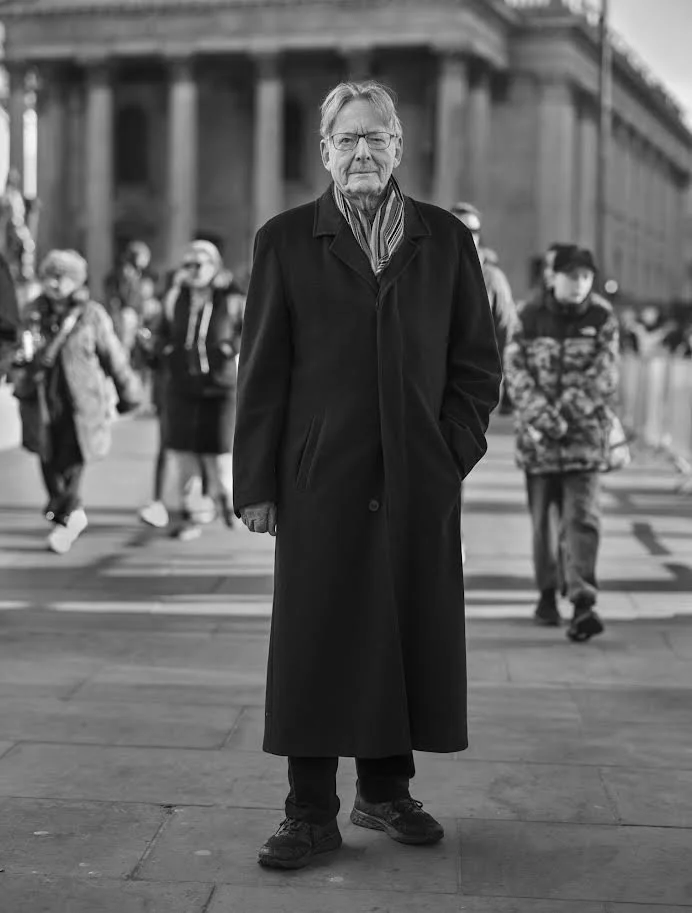
Although John Carewe is sometimes best known today as the teacher and mentor of Sir Simon Rattle (a friendship that has lasted well over 55 years), he has had a long and interesting conducting career himself.
Very early in his student days at the Guildhall School of Music (1950-55) John Carewe gave up his original intention of becoming a composer and turned to conducting. His teachers, nevertheless, were all composers: Walter Goehr, Max Deutsch (both Schoenberg pupils), Messiaen (with whom he studied in Paris on a French Government Scholarship) and Pierre Boulez. His early career then naturally reflected his interest in the music of our time, and in 1958 he founded The New Music Ensemble in London. During the next eight years he gave many British premieres of music by such composers as Birtwistle, Maxwell Davies, Boulez, Goehr, Messiaen, Milhaud, Maderna, Nono, Dallapiccola and Stockhausen, giving concerts at most of the major British music festivals. He conducted the first presentation of Boulez’ signature work, le marteau sans maître by a British ensemble at Dartington in 1960 and repeated this at the first of the now famous BBC Invitation Concerts in January 1961. His reputation in new music circles prompted an invitation to join Norman Del Mar and Alexander Gibson as conductors in the British premiere of Stockhausen’s Gruppen - given in Glasgow in 1961.
In 1966 John Carewe was invited by (Sir) William Glock to become the Principal Conductor of the BBC Welsh Orchestra. During his five years and nearly 400 concerts in Wales he had ample opportunity to expand and develop his repertoire whilst dramatically improving the standard of the orchestra. From 1974 to 1986 Carewe was Music Director of the Brighton Philharmonic Society giving concerts with some of the most famous international soloists of the time. He introduced such figures as Paul Tortelier, Gorge Bolet, Emannuel Ax, Moura Lympany, Ruggiero Ricci, Lyn Harrell, Ida Haendel, Clifford Curzon, John Ogden, Kyung Wha Chung, Shura Cherkassky – many of them later appearing in Brighton regularly. During this period, he was also Principal Conductor of The Fires of London (1980 to 1984) with whom he premiered many of Peter Maxwell Davies’ new works, appearing with them in tours encompassing London concerts, European festivals as well as New York.
His exploration of standard classical and romantic repertoire developed in long annual visits to South America (between 1973 and 1980) initially at the invitation of the British Council. In Buenos Aires, Santiago, Montevideo and Rio de Janeiro he conducted the major orchestras until the Falklands war interrupted this regular aspect of his life.
Since 1980 Carewe has been chiefly occupied as a guest conductor in Germany, Scandinavia, Holland, Switzerland and France. He worked most frequently with the radio symphony orchestras of Berlin, Cologne and Saarbrucken, where his programmes ranged from Haydn and Mozart to Rachmaninoff, Britten, Elgar and Busoni. At the same time, he began a relationship with the Nice Philharmonic beginning with Mahler’s Second and Seventh symphonies, which then climaxed in Pierre Medecin’s production of Debussy’s Pélleas et Mélisande - which became a widely acclaimed recording. In Sweden he appeared with the Stockholm Philharmonic giving the Swedish premiere of Turangalila in 1982, and in 1989 gave three performances of Gurrelieder with Stockholm Opera, including one at the Savonliina Festival.
In Switzerland he was a regular visitor to the Basel Radio Orchestra, and in 1988 he conducted the world premiere of Elliot Carter’s Oboe Concerto with Heinz Holliger and the Collegum Musicum in Zurich; in Holland he made radio recordings at Hilversum.
A rare trip to the US came in January 1990 where he made his Carnegie Hall debut with the American Symphony Orchestra in Mahler’s Seventh Symphony. In 1996 he was involved with Sir Simon Rattle and Daniel Harding in televised performances of Gruppen in Birmingham, London and Vienna. (Three master/pupil relationships!).
In 1993 Carewe accepted an appointment as General Music Director of the Chemnitz Opera and the Robert Schumann Philharmonic, where he won a national prize for his season’s programme planning. Amongst the major works he featured were Berlioz Romeo and Juliet, Mahler’s Third Symphony, Turangalila and the local premiere of Britten’s War Requiem on the 50th anniversary of the fire-bombing of Chemnitz. Operas he conducted in Chemnitz included Salome, Carmen, The Rake’s Progress and La Traviata.
His work with young people came to prominence with the Glasgow Schools Orchestra in the first International Festival of Youth Orchestras held in Aberdeen (1973); but he has enjoyed working with many others including the Northern Junior Philharmonic and five periods with the German Bundesjugend Orchestra. He has a reputation as a committed and sympathetic teacher working at different times with both the Royal Academy of Music and the Royal College. He curated several important composer festivals at RAM including a focus on Varèse and another on Messiaen, which his beloved teacher attended.
Amongst a long list of recordings some highlights include The Soldier’s Tale with Creation du monde (LSO Ensemble), Colin Matthews Cello Concerto and Landscape (Berlin RSO/Sinfonietta); Frank Bridge Oration (Baillie) Enter Spring (WDR SO); David Matthews Cantiga, Seventh Symphony, Mahler’s Seven Early Songs (Gomez), Bournemouth SO; Prokofiev Classical Symphony/Fifth Symphony (Robert Schumann Phil Chemntiz). Schoenberg’s Erwartung, Zemlinsky and Schreker songs with Eva Marton. Debussy’s Pelléas et Mélisande, Dvorak’s Seventh Symphony/Brahms Tragic Overture; Kindertoten Lieder, Elgar Sea Pictures, Zemlinsky Songs (Brigitta Svenden) all with the Nice Philharmonic.